Costa Rica isn't expensive for what it offers
Six verified reasons to understand why the price you pay isn't a market whim, but the visible consequence of decisions few Latin American countries ever made
A clarification before we begin.
This article isn't about the cost of living in Costa Rica. That complaint is real, justified, and deserves its own analysis: salaries that don't stretch far enough, rents climbing faster than wages, a basic grocery basket that's become a monthly math problem. We won't be debating that here. That's another conversation.
This article is about the cost of traveling within Costa Rica. About the Costa Rican who opens two browser tabs — one with a hotel in Manuel Antonio, the other with a flight to Panama — and concludes it's cheaper to leave the country than to explore it. That calculation is also real. But it's incomplete.
What follows are six data points, all verified through primary institutional sources, that shift the meaning of the math. This isn't a defense of the price. It's an inventory of what that price sustains.
What you see wasn't here forty years ago
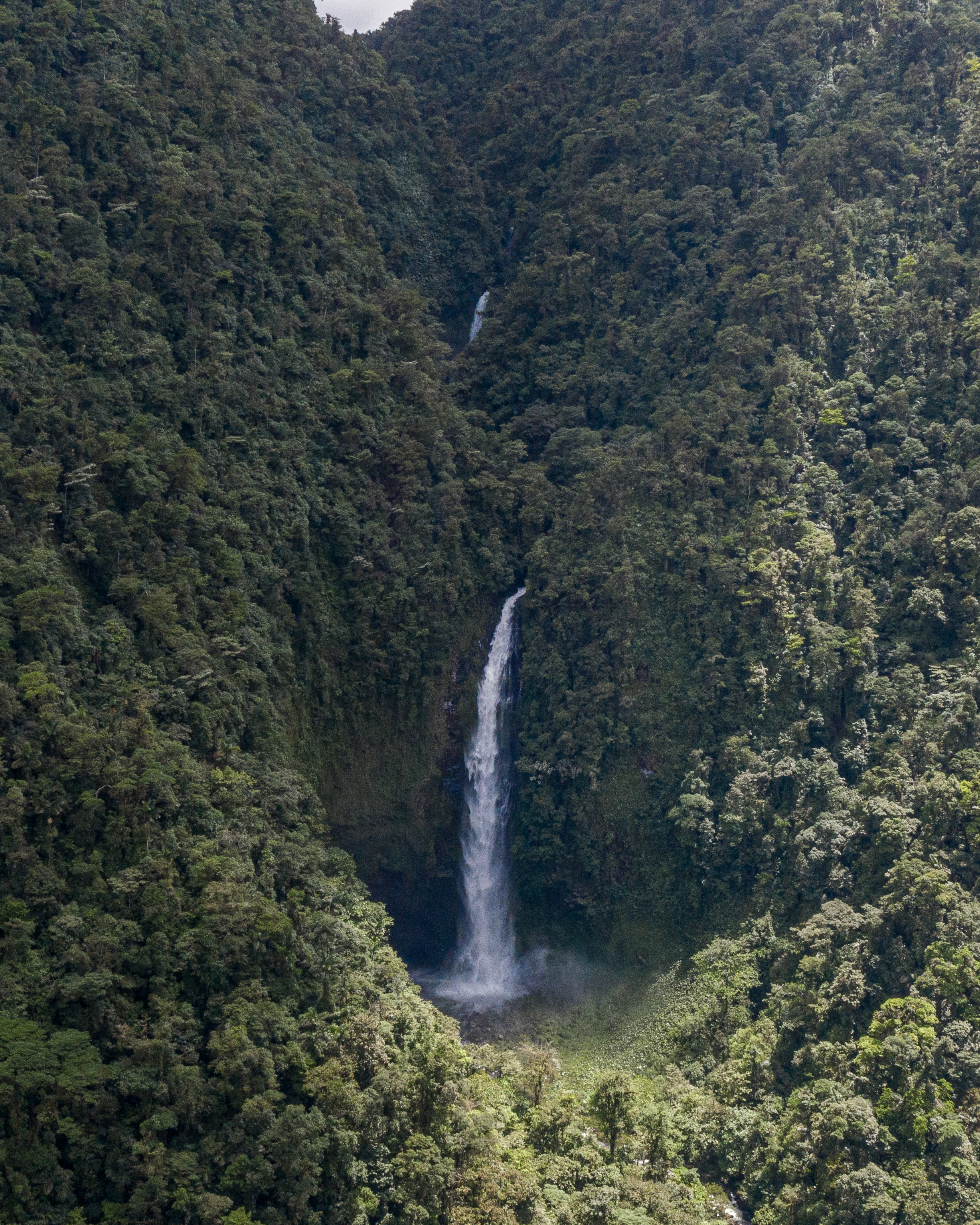
Let's start with the most underestimated fact in the entire Costa Rican inventory. The forest you drive through when leaving the city — the green canopy blanketing the Pacific slopes, the central mountain ranges, the northern and Caribbean zones — is, to a significant degree, a rebuilt forest.
In 1987, after decades of agricultural expansion, extensive cattle ranching and unregulated logging, Costa Rica had reduced its rainforest to just 21% of national territory1. It was one of the most deforested countries in Latin America. Thirty-six years later, according to Estado de la Nación 2023, forest cover reached 57.1% — and the most recent map from SINAC and UNDP reports 58.4%.
Costa Rica is the only tropical country in the world to have reversed its deforestation. This isn't a tourist factoid — it's a case study taught in environmental policy programs from Yale to Singapore.
How was it achieved? Through a specific mechanism: the Payment for Environmental Services Program (PSA), run by Fonafifo since 1997. The State pays private landowners to conserve forest rather than cut it down. And the money for those payments comes, in large part, from taxes on fossil fuels.
Read that again: every time someone fills up with gas in Costa Rica, they're paying for the forest to grow. Visitors do the same without realizing it — on every tour, every transfer, every domestic flight.
One nuance worth declaring: not all of that 57% is mature forest. Roughly 31% is mature forest, with the rest at various stages of secondary regeneration. That doesn't weaken the argument — it sharpens it. What you're seeing as you drive the Pan-American Highway toward the South Pacific is active regeneration, ecosystems in the process of returning. And that, anywhere else in the tropics, is exceptional.
The planet concentrated its life here
The second reason is geographical, but it has direct economic consequences.
Costa Rica covers 51,100 km². That's 0.03% of the planet's land surface — roughly the size of Switzerland, or West Virginia. Within that territory live approximately 120,000 known species2, and the species density per square kilometer is the highest in the world: close to 1.8 species per km².
Put another way: if you divided Costa Rica into a one-kilometer grid, each square would contain on average nearly twice as many species as the equivalent square in any other country.
This isn't a curious factoid for tourism brochures. It has practical consequences:
- Conservation infrastructure (park rangers, monitoring, research) has to cover exceptional biological density on a limited public budget
- Ecotourism, the economic backbone of entire regions, depends on keeping that density intact
- Hotel operating costs in remote areas are high because logistics (access, fuel, transport of supplies) compete with conservation of the surrounding environment
The tour you pay a premium for in Corcovado or Tortuguero isn't sustained by cheap mass tourism. It's sustained by low-volume, higher-priced tourism that covers the cost of keeping one of the densest concentrations of life on the planet intact.
Twelve ecosystems within three hours of your front door
Biodiversity per square kilometer is one data point. The distribution of that biodiversity across distinct ecosystems is another.
In 1969, biologist Joseph Tosi published the Ecological Map of Costa Rica based on L.R. Holdridge's world life zone classification system3. Holdridge was an American ecologist who had founded the Centro Científico Tropical in San José in 1962 — Costa Rica was the laboratory where the most widely used ecological classification system in the world was developed. Today, the FAO, IICA, and universities in dozens of countries use it for climate change studies and environmental planning.
The system classifies ecosystems by three variables: temperature, precipitation and evapotranspiration. For Costa Rica, the result was twelve life zones: dry forests of the North Pacific, premontane humid forests of the Central Valley, cloud forests of Monteverde, tropical rainforests of the South Caribbean, páramos atop Chirripó, mangroves on both coasts.
What's remarkable isn't the number — it's the distribution. Those twelve ecosystems aren't separated by thousands of kilometers. They're concentrated inside a country smaller than many states in Mexico or Brazil. From San José you can have breakfast in the Central Valley, lunch in Guanacaste's dry forest, and dinner on the South Caribbean. Same day, three radically different ecosystems.
In other countries in the region, seeing that kind of diversity means internal flights, days of driving, time-zone changes. Here it means a rental car and hours, not days.
You have twelve ecosystems within three hours of home. That's the product. When you compare the cost of a weekend in Costa Rica with a weekend somewhere else, that density doesn't show up in the Excel column. But it's there.
More than a quarter of the country generates no money. By law.
Now we enter the territory of political decisions — the ones that explain why Costa Rica still has what it has while neighbors with similar biodiversity lost theirs.
According to the Sixth National Report to the Convention on Biological Diversity, 27.41% of Costa Rican territory falls under some category of legal protection4. That breaks down into 26.51% terrestrial and 2.75% marine, after the creation of two new marine protected areas in 2017 and 2018.
That 27% generates no income through development, agriculture or extraction. No hotels are built there. No minerals are mined. No timber is cut. No pineapple or African palm is planted. It's territory the State chose to keep out of the traditional productive economy.
The cost of that decision is real, even if it doesn't appear on a single invoice. It's a distributed cost: public budget to maintain national parks, salaries for rangers in remote zones, ongoing biological monitoring, basic visitor infrastructure (trails, restrooms, information centers). And much of that is paid for by tourism entering those areas.
What makes that 27% strategic rather than merely administrative is its counterpart: it safeguards 74% of the key biodiversity areas identified globally. Costa Rica concentrated its conservation in the right places. It didn't protect for the sake of protecting — it protected where the planet's life needed to be protected.
When you pay the entrance fee to Manuel Antonio, Corcovado, Tortuguero or Rincón de la Vieja, you're financing an infrastructure that doesn't exist in other countries because those governments chose to exploit those territories instead.
The electricity you use has already paid for its transition
The fifth reason is invisible to the visitor, but present in every hotel room, every tour, every dinner.
The Instituto Costarricense de Electricidad reported that in 2025, national electricity generation was 98.6% renewable5. The mix includes water (hydro), geothermal (active volcanoes like Miravalles and Las Pailas), wind (the Guanacaste mountain range), biomass and solar. Fossil-fuel thermal generation came in at just over 1%.
That transition wasn't free or fast. The hydroelectric dams, the geothermal plants, the wind farms — all of it was built over decades with public financing that had to be recovered through electricity tariffs. Electricity in Costa Rica isn't the cheapest in the region, and that is precisely the reason.
A required nuance: in 2024, the percentage dropped to 86% due to a severe drought that cut hydroelectric flow by as much as 70%, forcing the use of thermal backup. The country is vulnerable to climate change on this indicator, and that's worth declaring. The line isn't always 98.6% — it's 98.6% in normal years, with possible dips in dry ones.
But the historical average over the past two decades has stayed above 90%. That's paid for through residential and commercial electricity bills. It's also paid by every hotel running air conditioning in tropical zones. And, indirectly, by the visitor in the price of the room.
National electrical coverage is 99.4% — among the highest on the continent. In areas where running power lines isn't economically justifiable, the State does it anyway. That's also baked into the price of the ticket you buy.
One of five places on Earth where people live longer
The sixth reason is the most internationally famous — and the least understood locally.
The Nicoya Peninsula is one of the world's five Blue Zones, alongside Okinawa (Japan), Ikaria (Greece), Sardinia (Italy) and Loma Linda (California). Dan Buettner popularized this with National Geographic, but here's something the world is less aware of: the original research was Costa Rican.
Demographer Luis Rosero-Bixby, of the Central American Population Center at the University of Costa Rica, led the CRELES project (Costa Rica: Longevity and Healthy Aging Study) between 2004 and 20076. His data showed that mortality among people over 90 in Nicoya is 10% lower than in the rest of Costa Rica. People born in the 1900s had, on average, 26 more years of life expectancy upon reaching 60 — versus 19 years in the rest of the country.
The world discovered Nicoya. But a Costa Rican documented the data first.
Here comes the nuance that distinguishes journalism from propaganda: the Nicoya Blue Zone is in verified decline. Rosero-Bixby has been clear about this: subsequent generations have gradually been losing that advantage. Once the generation born in the 1900s passes — within the next decade — Nicoya will likely stop being exceptional for longevity.
The causes are well documented: dietary shifts (more processed food, less traditional cuisine), labor migration that breaks up multigenerational family structures, rising pesticide use in agriculture, more sedentary lifestyles. Costa Rica faces the same public health problems as the rest of the developed world.
That doesn't invalidate the data — it contextualizes it. Nicoya is a Blue Zone today. It's at risk of not being one a decade from now. Your visit indirectly funds the public health system (Caja Costarricense de Seguro Social) that operates in zones where it makes no economic sense — including rural Nicoya — and that is part of the infrastructure that made that longevity possible in the first place.
Worth what it costs
Back to the original calculation: the Costa Rican comparing hotels in Manuel Antonio against flights to Panama. The math is still real. Panama may be cheaper. So may Colombia. So, depending on where, may Mexico.
What the Excel summary leaves out is this:
- A country that rebuilt its forest from 21% to 57% in forty years
- The highest biological concentration per square kilometer on the planet
- Twelve distinct ecosystems accessible in hours, not days
- More than a quarter of the territory removed from the productive economy by legal decree
- An almost entirely renewable electric grid, paid down through tariffs over decades
- One of five places on Earth studied for its longevity — documented first by Costa Ricans
Costa Rica isn't expensive. It's what it costs to have all of this.
The next time the numbers don't add up, do the full math. Not just the airfare and the hotel room. Include the forest you're looking at. The road that reaches places where it shouldn't be profitable to reach. The park you enter for twenty thousand colones that sustains an ecosystem the rest of the world has lost. The clean electricity. The park rangers. The public health system operating in remote regions.
This isn't propaganda — it's honest accounting.
Costa Rica isn't expensive. It's worth what it costs.